Delta neutral
Funding rate arbitrage: why the entry decides the profit
Long on one exchange, short the same coin on another, collect the funding rate and forget about price. That's the pitch of funding rate arbitrage, and on paper it works. Then you check the account two weeks later: the funding column has been green the whole time, and the PnL is flat or red. The funding was real. The money went out on the way in.
- Funding rate arbitrage holds a long and a short of the same coin on two exchanges. Price moves cancel out, and the difference between the two funding rates is the income.
- What you pay to get in (trading fees, the price gap between the exchanges and slippage) can take weeks of funding to recover.
- The entry decides the result: open at a gap in your favour, on books deep enough for your size, with both legs exactly the same size.
What funding rate arbitrage is
Perpetual futures never expire, so exchanges keep their price close to the spot price with funding: a regular payment between longs and shorts. When funding is positive, longs pay shorts; when it's negative, shorts pay longs. Each exchange sets its own rate, so the same coin can pay very different funding on two venues at the same time.
Funding rate arbitrage, also called delta neutral funding, opens the leg that collects the higher rate and hedges it with the opposite leg on the other exchange. If the price rises, one leg gains what the other loses. What's left is the difference between the two funding rates.
What a basic delta neutral bot does
It sends a market buy on exchange A and a market sell on exchange B, full size, and calls the position hedged. That skips the four things that decide whether the trade makes money.
The four things that decide the result
1. The gap between the two prices
The same coin rarely trades at exactly the same price on two exchanges. Buy the long leg at $100.10, sell the short at $100.00, and you've opened at a −0.10% gap. When the two prices converge, that 0.10% comes out of your pocket. Open it the other way round, with the short sold above the long, and the convergence pays you instead.
A bot that opens immediately takes whatever gap exists at that second, without checking which way it points. And a gap calculated from mark or mid prices always looks better than the one you'll actually get, because you buy at the ask and sell at the bid.
Opened at −0.10%
Convergence costs you $10 per $10,000.
Opened at +0.10%
Convergence pays you $10 per $10,000.
Best ask (where you buy)Best bid (where you sell)Your fill
2. The order book
A $10,000 market order on BTC barely moves the book. The same order on a smaller perp, on a smaller venue, can eat through several price levels. You pay that slippage on both legs, once to open and again to close. The highest funding rates tend to show up on exactly those thin markets.
Thin book
Average fill $100.15: 0.15% above the best ask.
Deep book
Average fill $100.02: 0.02% above the best ask.
Taken by a $10,000 market buyLeft in the book
3. One leg fills, the other doesn't
Two exchanges means two APIs with their own rules. One order fills and the other gets rejected: below the minimum size, wrong lot step, not enough margin, a rate limit, a venue hiccup. Now you're holding a naked long or short, which is the one thing this strategy exists to avoid.
Even when both fill, each venue rounds size to its own step. The two quantities can come out different, and that difference is directional exposure.
Case 1: one leg rejected
Case 2: both filled, different rounding
4. Funding moves
The APR on a screener is the latest rate, annualized. Spikes fade, sometimes within hours, sometimes before the position has paid back what it cost to open.
The math: same trade, two entries
Illustrative numbers: $10,000 on each leg, net funding of 15% APR and a 0.045% taker fee per fill. Funding earned: about $4.11 a day.
| Careless entry | Careful entry | |
|---|---|---|
| Taker fees, opening and closing both legs | $18 | $18 |
| Entry gap | −0.10%: costs $10 | +0.10%: pays $10 |
| Slippage at entry | 0.15% per leg: $30 | About $4 |
| Total | $58 | $12 |
| Days of funding to recover it | About 14 | About 3 |
If the rate flips on day 5, the careless entry closes at a loss and pays exit slippage on top. The coin and the funding rate are the same in both cases. The entry is the only difference.
Funding earnedCareless entry: $58Careful entry: $12
Try your own numbers
Fees count four fills: opening and closing both legs. Slippage counts the entry only. A positive gap means the short was sold above the long.
How the MyLiquidBot Delta Neutral bot enters
We built the Delta Neutral bot on MyLiquidBot around the entry, because that's where these trades are won or lost.
- It measures the gap at prices you can trade. The long leg is priced at its ask and the short leg at its bid. You set a target gap and the bot waits for it, checking four times a second.
- It opens in slices. Each slice has the same quantity on both legs, rounded to a size both exchanges accept and above each venue's minimum order, so the two fills match.
- It reads both order books before every slice and counts only the depth priced within your target gap. When the book is thin, the bot waits for liquidity instead of paying through it.
- It takes a last look. With both orders ready, it reads the gap once more. If it has slipped below your target, nothing gets sent.
- It sends both legs at the same time.
- It keeps the legs equal. If one ends up bigger, the bot rebalances before doing anything else. If an exchange keeps rejecting one leg while opening, the bot trims the other leg to match instead of chasing the price, and alerts you within 30 seconds. It never sends a new order while an earlier one is still unconfirmed.
Closing works on the gap too. You set a close target and the bot waits for the gap to come back to it, or you exit straight away with Close now.
What you control
Compare your exchanges lists funding combinations across the exchanges you've connected. For each one it shows funding APR, the indicative gap, 24h volume (flagged when it's low) and Net 7d: funding minus the fees of opening and closing both legs, plus how many hours of funding it takes to cover them. You can backtest your own size against recorded funding history before you commit anything.
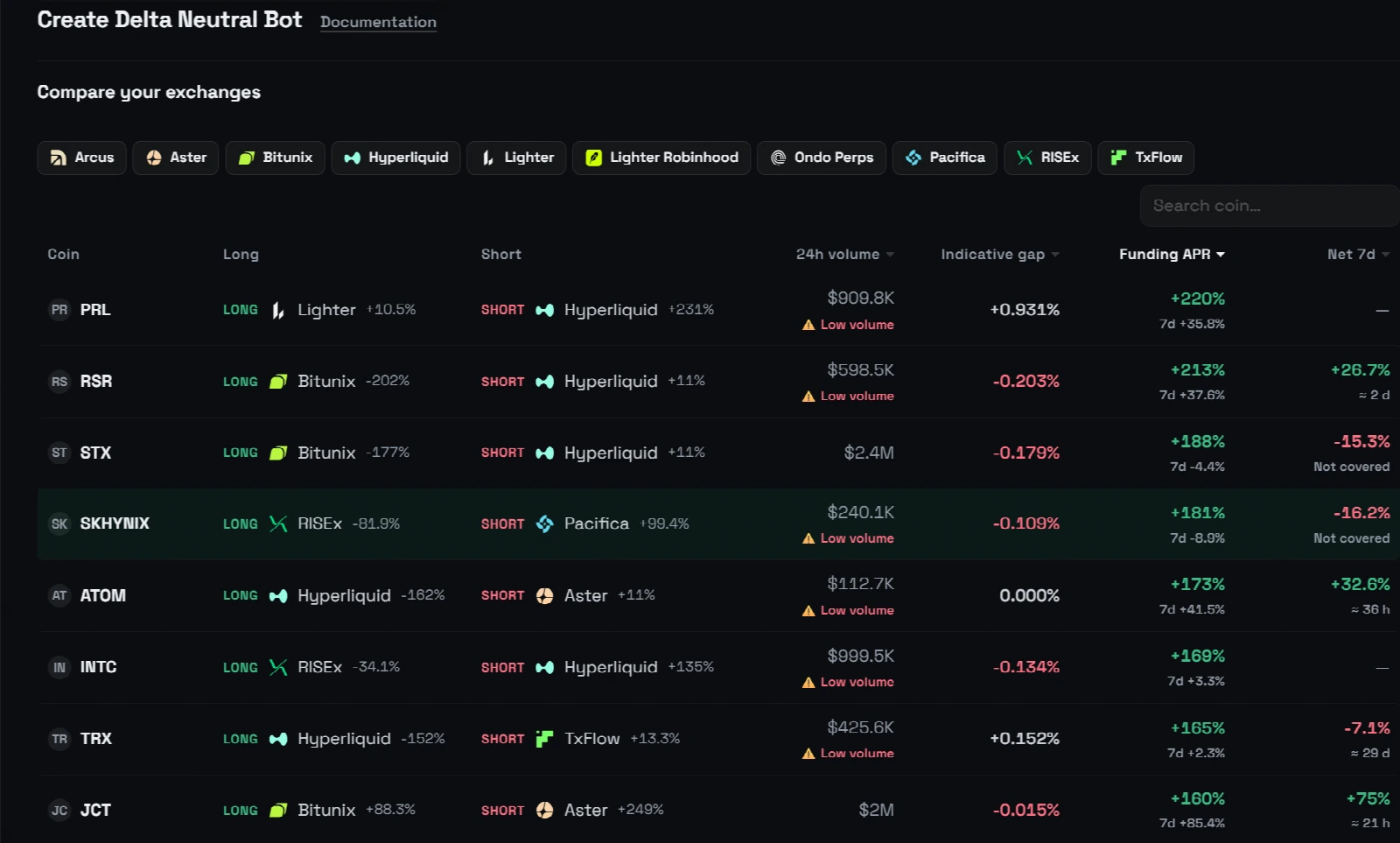
Then you pick:
- exchange, market and direction for each leg (perp + perp, or spot + perp)
- leverage, and cross or isolated margin, for each leg
- how the capital is split between the two legs
- an entry gap target, or Open now if you only care about funding
- a close gap target, or Close now
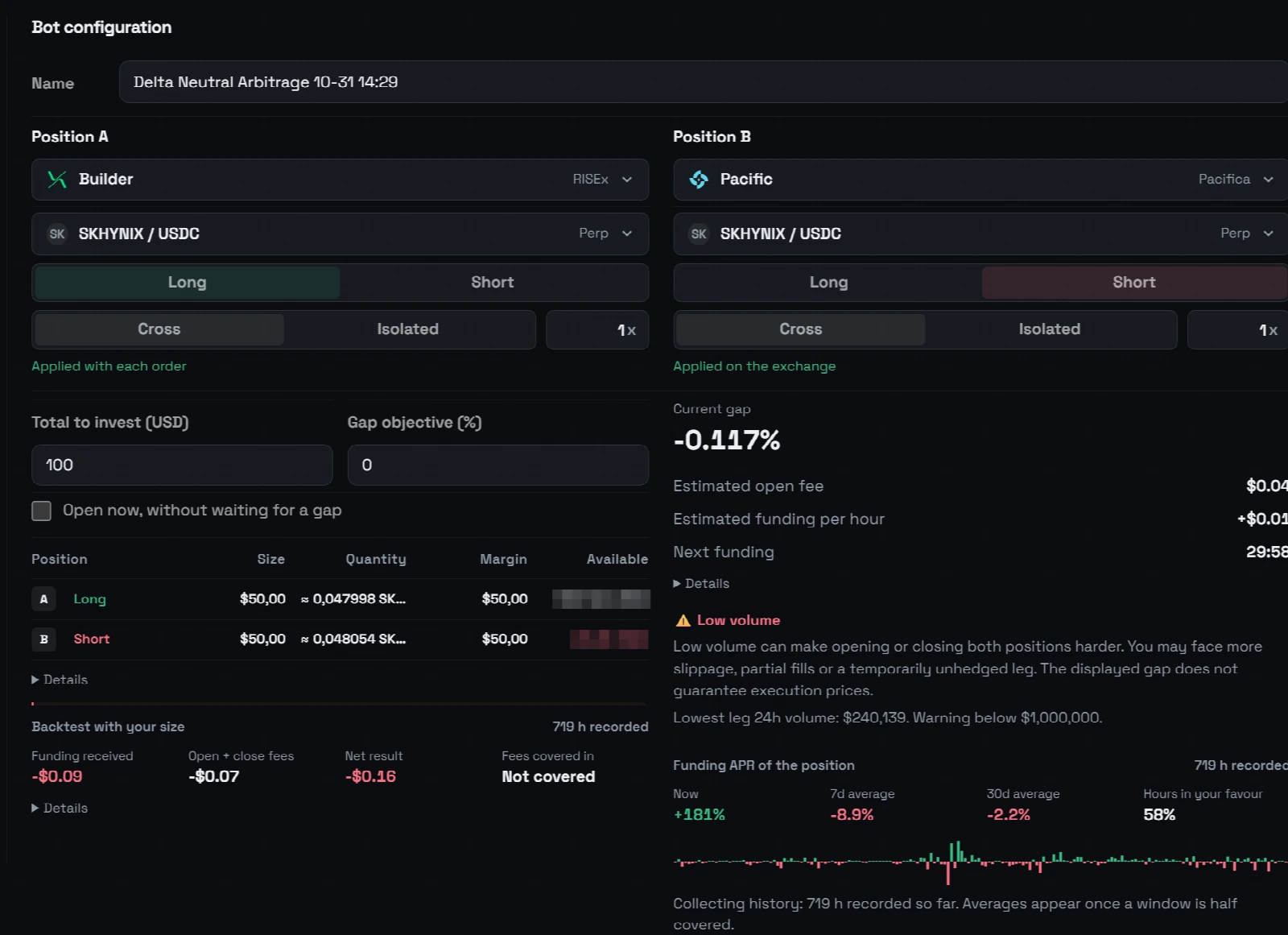
Once it's running, you can add capital, close 25%, 50%, 75% or any share you choose, and adjust the gap targets from the bot page. Gap profit, funding earned and fees are shown separately, so you can see exactly where the result comes from.
While positions are open, the bot checks both exchanges every few minutes and alerts you if a leg disappears, the legs drift out of balance, or a perp leg gets within 15% of its liquidation price.
Supported exchanges: Hyperliquid, Lighter (including Robinhood Chain), Aster, Bitunix, Pacifica, Ondo Perps, RISEx, Arcus and TxFlow. Spot legs are available on Hyperliquid and Aster.
Fees
Each leg opens and closes with market orders, so it pays the exchange's taker fee on every fill. Those fees are already included in the Net 7d figure and in the backtest. Delta Neutral has its own MyLiquidBot fee, listed on the Fees page.
Delta Neutral promotion: no MyLiquidBot fee for now. Exchange fees still apply.
Risks to keep in mind
Delta neutral is not risk-free. Funding can turn against you. A leveraged leg can be liquidated if the price runs far, even though the other leg is in profit, because that profit sits on a different exchange. And an exchange can go down while you hold a position. Size each leg so it can take a large move, and keep the alerts on.
Frequently asked questions
Is funding rate arbitrage risk-free?
No. Price moves cancel out, but fees, the entry gap, slippage, a change in funding or the liquidation of a leveraged leg can all turn the result negative.
What is the entry gap?
The difference between the price you sell the short at and the price you buy the long at, measured at prices you can actually trade (bid and ask) and shown as a percentage. Positive means the short was sold above the long, so the convergence of the two prices pays you.
How long does it take to recover the entry costs?
Divide the total cost of opening and closing by the funding you earn per day. In the example above, about 3 days for a careful entry and 14 for a careless one. The calculator does it with your own numbers.
Can one leg be spot?
Yes. On MyLiquidBot, spot legs are available on Hyperliquid and Aster, paired with a perp leg on the other exchange.