Manual trading
What is exit liquidity in crypto, and how not to become it
Exit liquidity is the buying that a large holder needs on the other side to sell a big position without crashing the price. In crypto slang, being someone's exit liquidity means you were that buyer: you bought the top that someone else was selling into, and they left with the profit.
- Every sale needs a buyer. A large holder can't sell millions at once into a quiet order book without pushing the price down against itself.
- So large holders sell when buyers rush in: breakouts, hype, listings and, in perpetual futures, short squeezes, where every liquidated short is a forced market buy.
- Before you buy a fast move up, check who is selling: large wallets reducing, buying that no longer lifts the price, and sell walls above.
What exit liquidity means
The phrase has two uses. In the neutral sense, exit liquidity is the demand that lets someone leave a position: enough bids in the order book, close to the price, to absorb a sale. Deep markets have plenty of it; thin ones have very little.
In crypto slang it is an accusation. "You are exit liquidity" means your buy was the counterpart someone needed to cash out: an early holder, a fund, a team with unlocked tokens or a whale that bought much lower. They sold to you at a good price, and the price then fell under your entry.
Nothing about it is wrong in itself: every trade has a buyer and a seller. It becomes a trap when the selling is hidden behind hype, or when the buying it relies on is forced, as in a squeeze.
Why large holders need it
A market sell walks down the order book: it takes the best bid, then the next one, until it is filled. Nobody notices a small order. A large one lowers the price of everything it sells after the first level.
Into a quiet book
Average fill 0.990, 1% under the price, and the price is left at 0.980.
Into a squeeze
The buyers come on their own. The whole $3M fills at the top with no slippage.
Buying that fills the saleThe saleBids not used
That's why a large holder waits for buyers to come. A quiet market makes it pay for every dollar it sells; a crowd rushing in pays it instead. The crowd is the exit liquidity.
How exit liquidity is created
- Breakouts and new highs. Breakout traders buy above resistance, and their buy stops fire on the way up. A large seller can fill into that burst.
- Hype, listings and announcements. News and social media bring in buyers who don't look at who is selling.
- Token unlocks and airdrops. New supply reaches holders who want to sell, and they need buyers.
- Short squeezes. In perpetual futures, a liquidated short is closed with a market buy. A cluster of short liquidations above the price is guaranteed buying, and it fires exactly when price spikes into it.
- Low-float pumps. When few tokens trade, a small push moves the price a lot and draws buyers in, and the holders of the rest sell into them. At its worst, this is a pump and dump.
Exit liquidity in perpetual futures
Perps make the mechanism visible. Imagine a whale with a long of a few million dollars on an altcoin that has already run. To take profit it needs buyers. Above the price sits a cluster of short liquidations: traders who shorted the run with leverage. If price reaches them, each one becomes a forced market buy, and the whale can sell its long into those buys.
It works the other way too. A whale short needs sellers to close, and a cluster of long liquidations under the price is guaranteed selling. That is one reason price is drawn to liquidation clusters, as How to read a liquidation heatmap explains, and why a liquidity sweep so often happens right where a large position wants out.
Funding tells you how crowded a side is. When funding is high and open interest climbs with the price, longs are crowded and paying to stay in. That is when late buyers are most likely to become someone else's exit.
Signs you may be the exit liquidity
None of them alone means the top is in. Together, they say that the traders with the largest positions are selling to the traders who just arrived.
A worked example
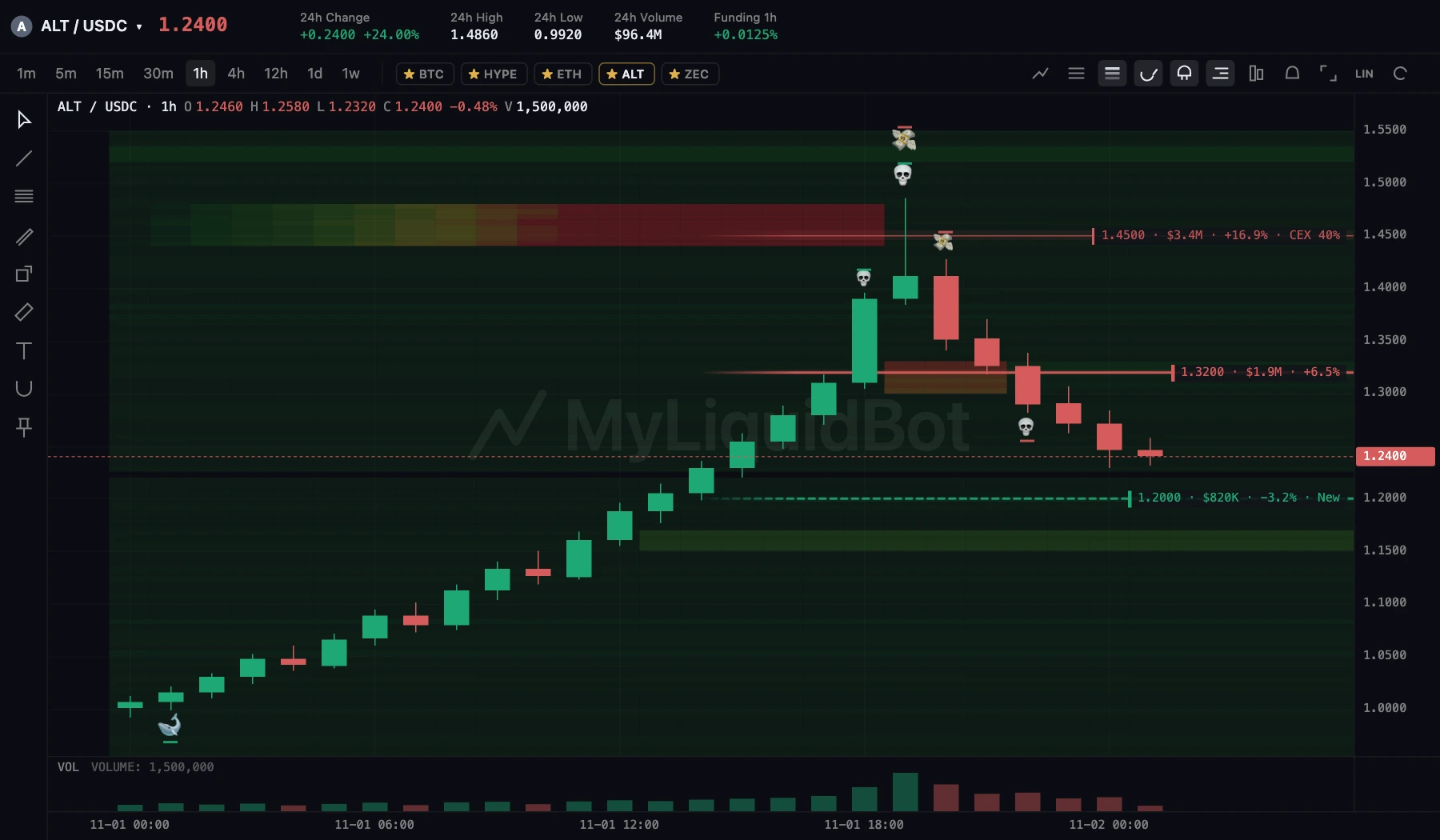
Illustrative numbers. A coin goes from 1.00 to 1.39 in a day. A whale bought near 1.01 at the start. Shorts have been fighting the move, and their liquidations stack at 1.44–1.48.
- A whale opens a large long near 1.01, shown as a Smart Money entry.
- Price spikes into the short liquidations. Each liquidated short is a forced market buy (skull), and the move looks like a breakout.
- The whale sells its long into those buys, shown as a Smart Money close. On the footprint, the top candle has heavy buying that did not push the price higher.
- The buyers at 1.45 were the exit. With the forced buying spent, the day ends at 1.24, 14% under their entry.
Short liquidationsWhere the late buyers got in
From the outside, the spike was the strongest moment of the day. From the order flow, it was the moment the largest holder could finally sell. Anyone who bought it because it looked strong did exactly what the whale needed.
How to avoid becoming exit liquidity
- Don't chase vertical moves into a cluster. If price is running into short liquidations or a sell wall, wait for the cluster to fire and for the next candles to show who is in control.
- Check who is selling. If the largest wallets are reducing while the price rises, you are buying from them.
- Prefer pullbacks to spikes. A retest that holds is a better entry than a spike, and it gives you a clear place for the stop.
- Use limit orders and a sensible size. Market buys at the top are the order flow that sellers want. Size the position so a normal pullback doesn't force you out.
- Know your liquidation price. High leverage at the top turns a normal pullback into a forced sale, and your liquidation becomes someone else's liquidity. Check it with the liquidation price calculator.
- Be the seller, not the buyer. If you are already in profit, a squeeze into short liquidations is a good place to take it: then you are the one using the exit liquidity.
Check it on MyLiquidBot
Every sign in the checklist is a tool on the Trade chart, free with an account and a connected exchange:
- Open Trade and the chart of the coin.
- Liquidation heatmap: where the short and long liquidation clusters sit.
- Whales: turn on Entries on the chart and Closes on the chart to see large wallets opening and reducing positions, and open each wallet's profile.
- Order book: the sell walls above the price and how long each one has been there.
- Footprint: whether the buying at the top still moves the price.
Without an account, the free BTC and ETH liquidation maps show the real Hyperliquid and Lighter positions and the largest order book walls.
Frequently asked questions
What does exit liquidity mean?
The buying a holder needs on the other side to sell a large position. In slang, being exit liquidity means buying the top that someone else sold into.
What does "you are exit liquidity" mean?
That your purchase let someone else cash out at a good price, and you were left holding the position as the price fell.
Is exit liquidity a scam?
Not by itself: every trade has two sides. It turns into one when insiders hide their selling behind hype, as in a pump and dump, or when a few wallets hold most of a token and sell into every new buyer.
How do whales find exit liquidity?
They sell when buyers arrive on their own: breakouts, news, listings and short squeezes, where liquidated shorts are forced to buy.
What is the difference between exit liquidity and a liquidity sweep?
A liquidity sweep is a move that sets off the stops and liquidations at a level. Exit liquidity is whoever absorbs a large seller. A sweep of short liquidations often creates exit liquidity for large longs.
Can I see exit liquidity on MyLiquidBot?
You can see its signs: liquidation clusters, large wallets opening and closing, order book walls and the footprint. The chart is free with an account and a connected exchange.